> ## Documentation Index
> Fetch the complete documentation index at: https://docs.tylon.app/llms.txt
> Use this file to discover all available pages before exploring further.
# Projects
> A project is a product the team ships — its repositories, its cards, its releases and its own flow.
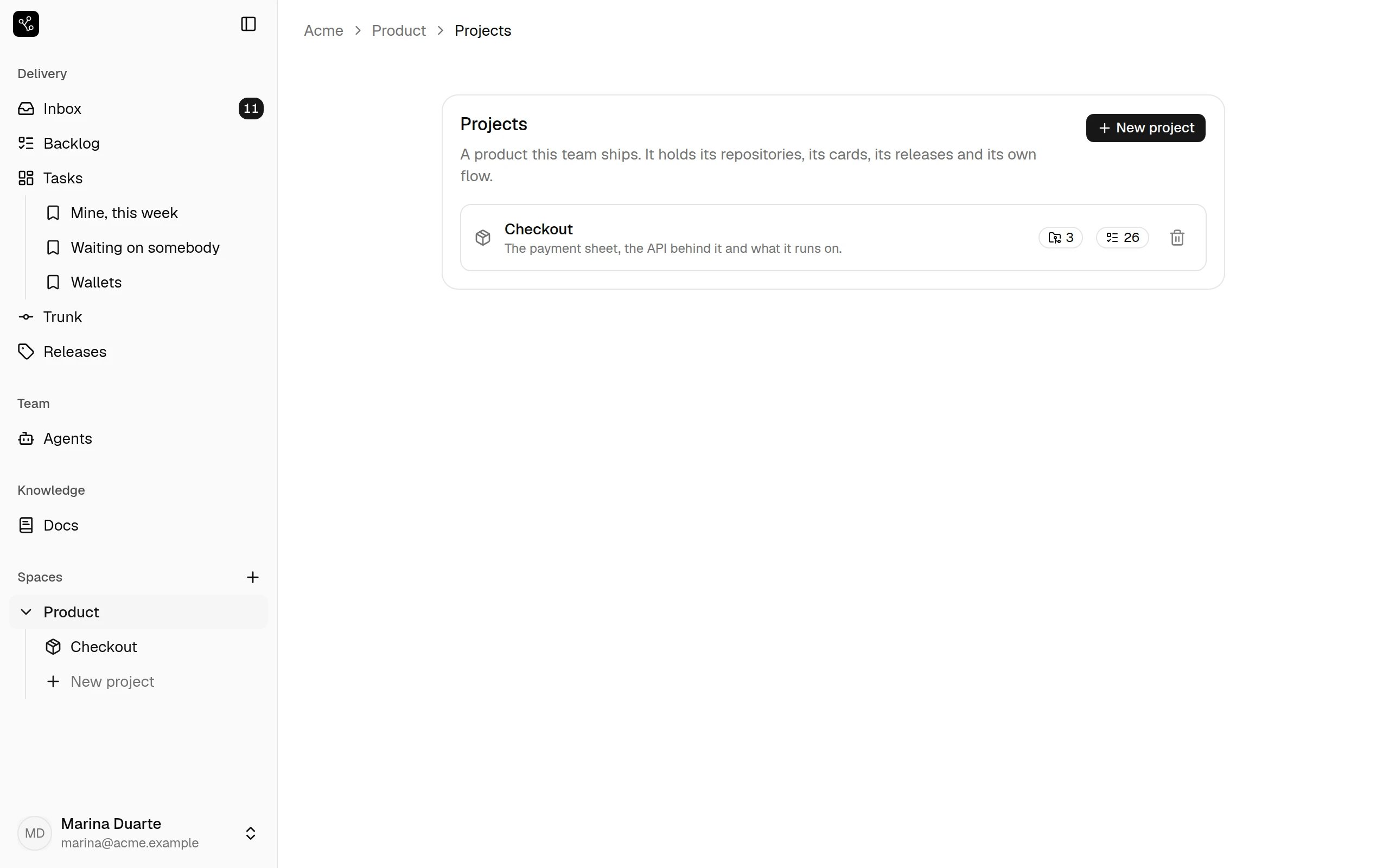
 A workspace holds projects. A project is *a product this team ships*, and it
owns the four things that make a board mean something: its repositories, its
cards, its releases and its own flow.
The count beside each one is what it is made of — repositories, then cards.
Two projects in one workspace move differently on purpose. A mobile app that
ships through a store review and an API that deploys on merge do not want
the same stages, and neither is made to pretend otherwise.
## Inside a project
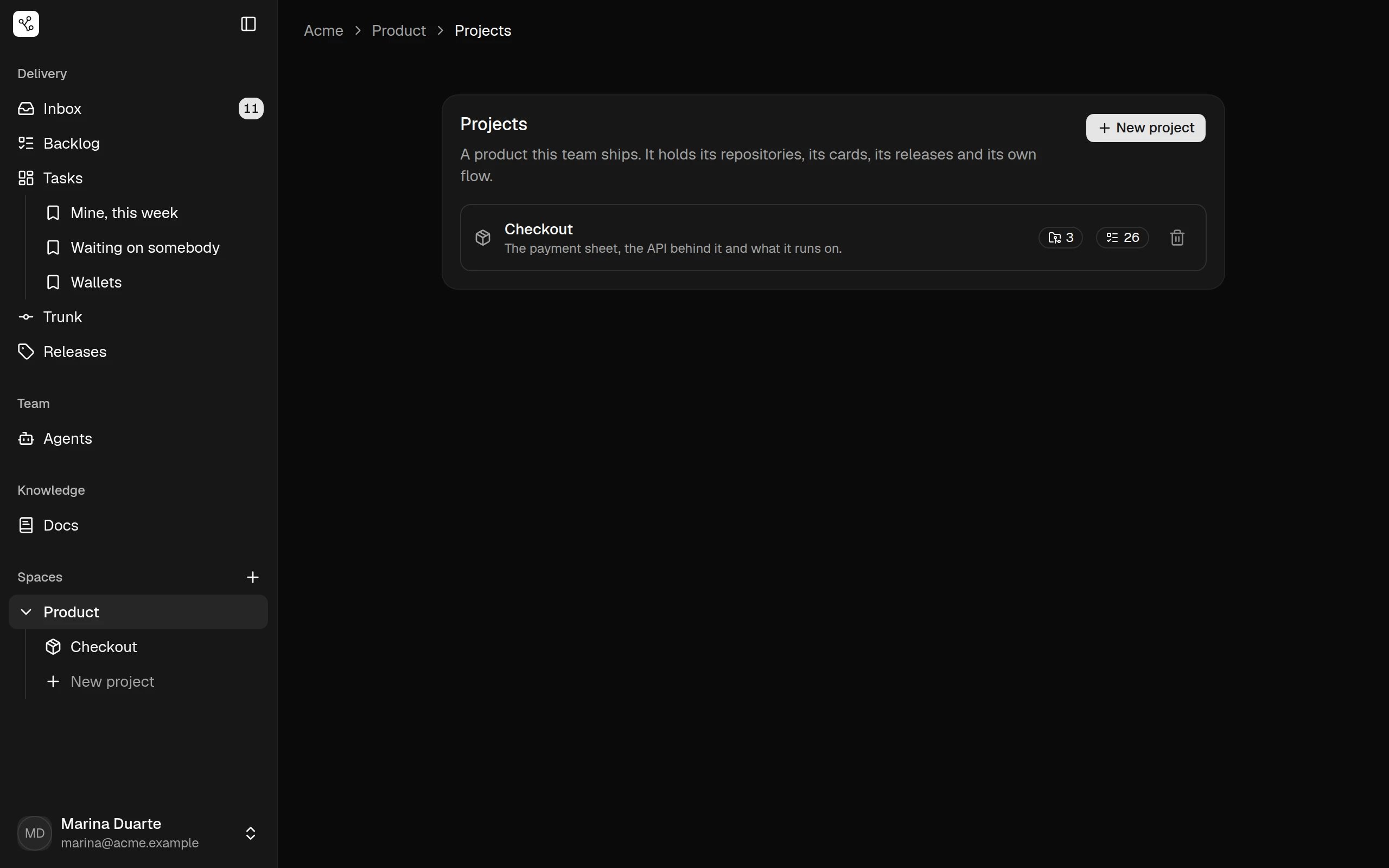
A workspace holds projects. A project is *a product this team ships*, and it
owns the four things that make a board mean something: its repositories, its
cards, its releases and its own flow.
The count beside each one is what it is made of — repositories, then cards.
Two projects in one workspace move differently on purpose. A mobile app that
ships through a store review and an API that deploys on merge do not want
the same stages, and neither is made to pretend otherwise.
## Inside a project
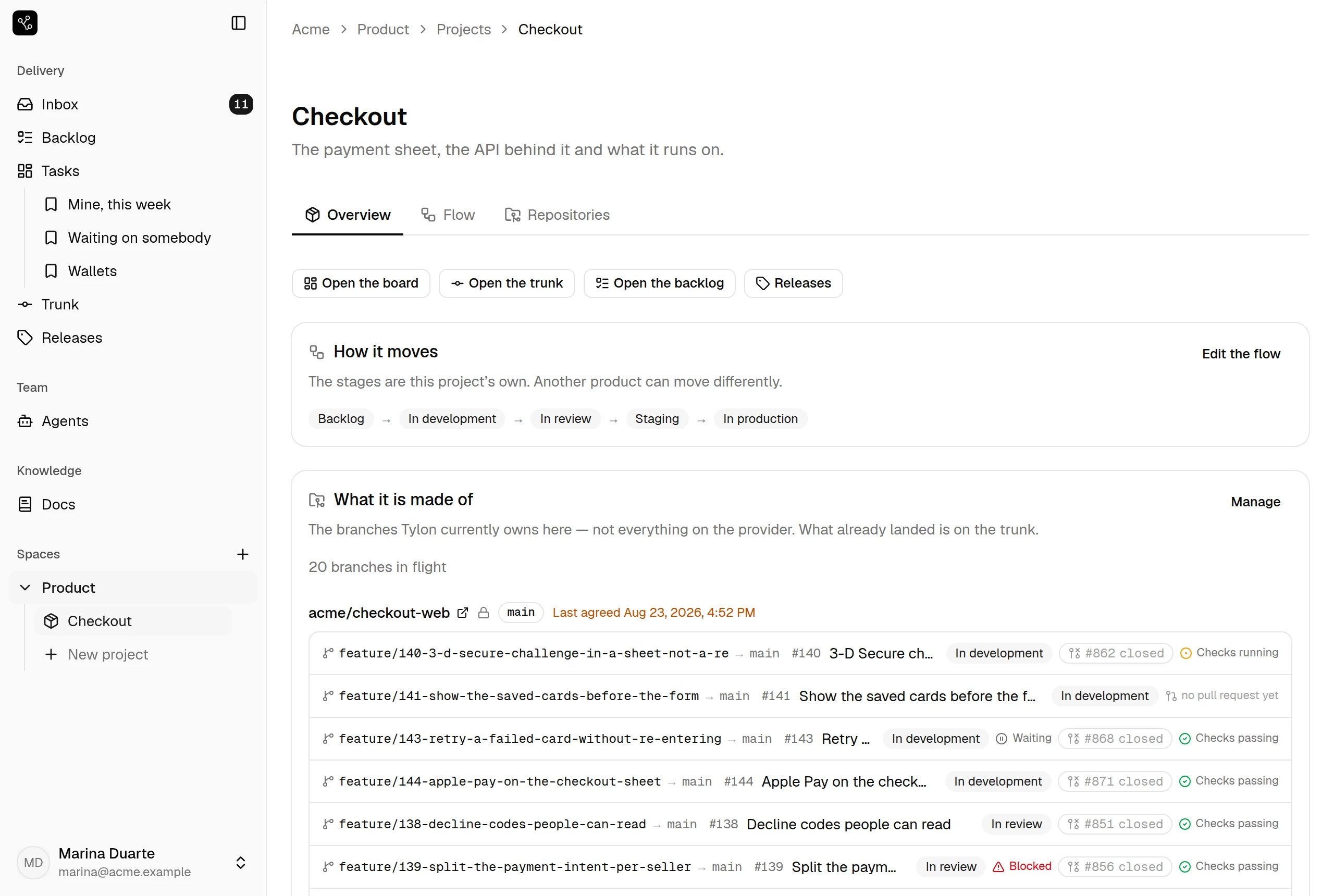
 **Overview**, **Flow** and **Repositories** — and along the top, the four
places the project's work actually is: its board, its trunk, its backlog, its
releases.
### How it moves
The stages, in order, as a sentence: `Backlog → In development → In review →
Staging → In production`. **Edit the flow** opens [the flow
screen](/en/screens/flow), where each of those stages gets its branch rule.
### What it is made of
The branches Tylon currently owns here — **not everything on the provider**.
That distinction is the point of the panel: `20 branches in flight` is work
this board is responsible for, and what already landed has left this list for
[the trunk](/en/screens/trunk).
Each repository names its default branch and when Tylon last agreed with the
provider about it. Under it, one line per branch:
```
feature/144-apple-pay-on-the-checkout-sheet → main #144 In development #871 closed Checks passing
feature/139-split-the-payment-intent-per-seller → main #139 In review Blocked #856 closed Checks passing
```
The branch, what it targets, the card it belongs to, the stage that card is
in, the pull request and what CI said. `Blocked` and `Waiting` sit on the same
line, so the reason a branch is not moving is on the row rather than one click
away.
A branch pushed with a name the convention does not recognise is not lost —
it arrives in [the inbox](/en/screens/inbox) to be adopted onto a card.
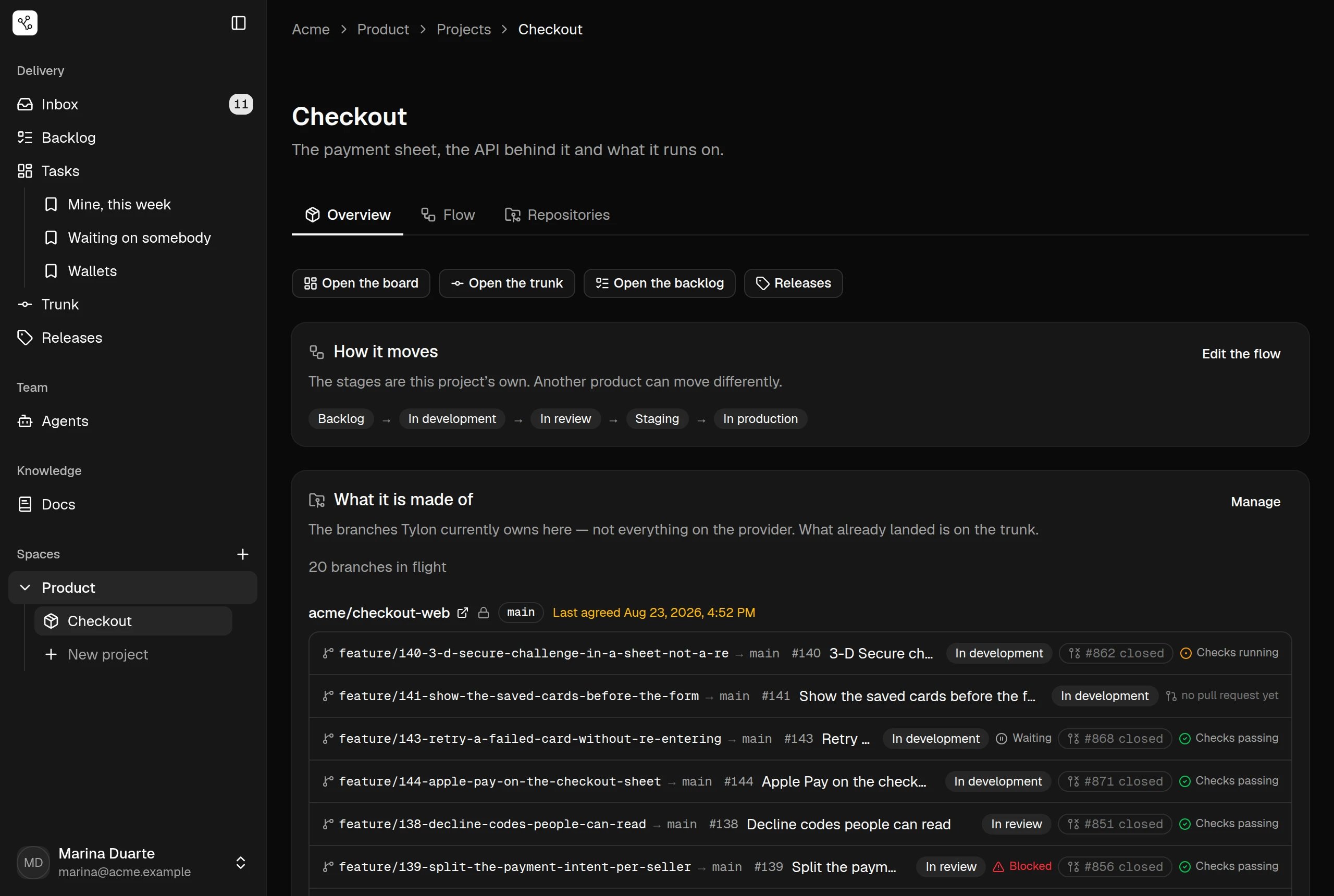
**Overview**, **Flow** and **Repositories** — and along the top, the four
places the project's work actually is: its board, its trunk, its backlog, its
releases.
### How it moves
The stages, in order, as a sentence: `Backlog → In development → In review →
Staging → In production`. **Edit the flow** opens [the flow
screen](/en/screens/flow), where each of those stages gets its branch rule.
### What it is made of
The branches Tylon currently owns here — **not everything on the provider**.
That distinction is the point of the panel: `20 branches in flight` is work
this board is responsible for, and what already landed has left this list for
[the trunk](/en/screens/trunk).
Each repository names its default branch and when Tylon last agreed with the
provider about it. Under it, one line per branch:
```
feature/144-apple-pay-on-the-checkout-sheet → main #144 In development #871 closed Checks passing
feature/139-split-the-payment-intent-per-seller → main #139 In review Blocked #856 closed Checks passing
```
The branch, what it targets, the card it belongs to, the stage that card is
in, the pull request and what CI said. `Blocked` and `Waiting` sit on the same
line, so the reason a branch is not moving is on the row rather than one click
away.
A branch pushed with a name the convention does not recognise is not lost —
it arrives in [the inbox](/en/screens/inbox) to be adopted onto a card.